Friday, April 15, 2011

Making Cassava Bread!

Cassava (Manihot esculenta), also called yuca or manioc, a woody shrub of the Euphorbiaceae (spurge family) native to South America, is extensively cultivated as an annual crop in tropical and subtropical regions for its edible starchy tuberous root, a major source of carbohydrates. Nigeria is the world's largest producer of cassava.
Cassava Leaves
A manioc tuber


_________________________________________________________________
This afternoon the girls asked me 
if I wanted to learn how to make
Cassava Bread! 
"YES!!!"
The Cassava had already been grated 
and was ready to use.
  First I watched, then Susy stood by 
and very carefully told me what to do, 
BUT she didn't do it, 
she let me do the whole thing! 
The fire was HOT HOT HOT. 
I tied up my skirt because I was afraid that 
the fire would catch the fabric.
I put the grated Cassava in a small pile on top 
of the hot TAWA.
You use a fan (which is made of woven vines) 
to smooth the Grated Cassava
into a circle in the middle of the "Tawa".
 As the Cassava Bread cooks, 
you take the knife and turn the edges inward.
Then you get ready to FLIP it! 
The fire is HOT HOT HOT
the Cassava Bread feels as though it will break...
I screamed as I flipped it!
We all LAUGHED!
 BUT I DID IT!
And then you let them dry in the sun!

Each day, I learn something new!
Last night, we served my very first
Cassava Bread with our Rum Punch!


It was So Good!


A

Tuesday, April 12, 2011

The Cats of Karanambu

Salvador and I have both always been “Cat People”.  And Karanambu has always be a home to cats of all kinds.  Frequently guests comment on our domestic cats, which are not as common in Guyana as they are in other parts of the world.

“Mongo”, also affectionately known as “The Old Man”, is well over 20 years now.  As the story goes…Diane’s niece was working for a veterinarian in town.  The Old Man’s owner had too many cats. The veterinarian informed the owner that she could keep only three, the others all needed to find homes.  Diane’s niece said she knew of one good home!  The cat was put in a cardboard box, marked KARANAMBU, and placed on the plane.  Diane opened the box, thinking that it was a box of greens from the market and out popped “Mongo”.  He was old when he arrived from GT…Diane is sure he is well over 20…. just not sure how much over. 
Then there is “Fancy Foot”. 
 
Fancy was born with deformed back feet, so he walks funny.  But always able to find the bright side, Di named him “Fancy Foot”.  He is sweet, but he is definitely HER CAT.  No one else can cuddle him.  He jumps into her lap whether she is sitting in a chair, lying in a hammock or sleeping, fast asleep in bed.
 And “Sir Walter Raleigh”
What a handsome, handsome cat.  He came to Diane as a kitten.  Brought to her by Dr. Graham Watkins.  Graham had asked her to look after Sir Walter for a while….and of course he is still here. Sir Walter is hunter…he jumps and runs up trees. Catches birds, lizards….chases around like a mad man at full speed.
And lastly….our little “Minxy"
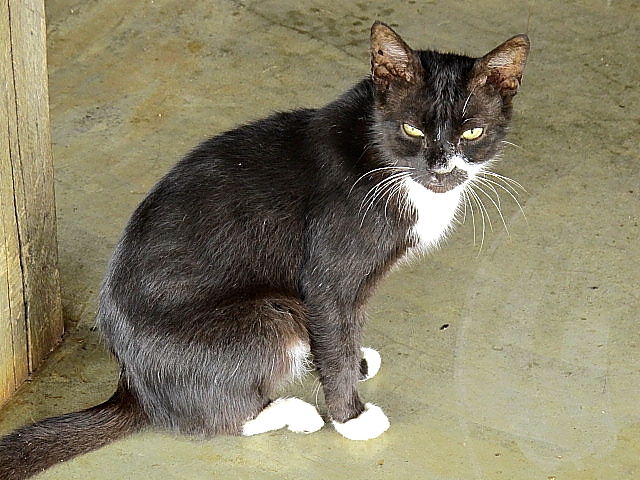
I was at the Corral one morning and there was this little one…no tail…covered in dirt…ticks…a pitiful sight. I picked her up and she purred.  I put her down and she followed me….next thing you know I scooped her up in my scarf and carried her home in the landrover.  Once home, I shampooed her in the sink with lots of bubbles…she just sat there and purred.  Slowly she became accustomed to her new home, although she never ventures very far away.
All the other cats came to meet little Minxy.
Now…all of the other cats are MALE...all have been neutered, with the exception of “the old man”, because it was felt that he was just too old to put him through that!  When I asked Dr. Lucy if she thought Minxy might get pregnant, she said that it was  very “unlikely”, because she was very young and he….well, he was VERY old.  Two other vets from Chicago came to visit. Both of them said, “Not likely”…. I would seriously doubt it”.
Well!!! 2 nights ago,
Minxy gave birth to two little ginger kittens!
 MEET Fred & Ginger
There was great excitement among the Staff!
There are also the other Cats of Karanambu!
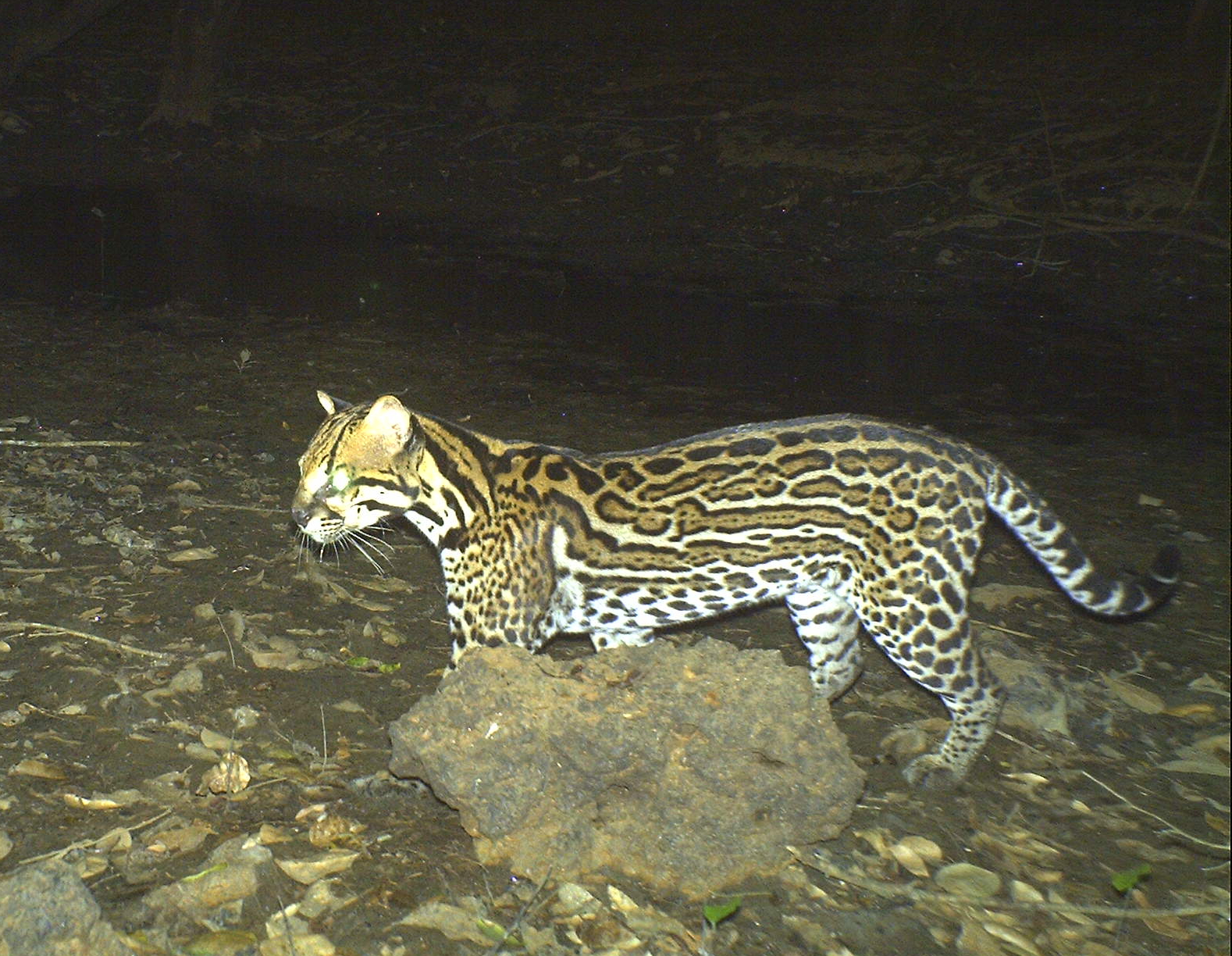
The PANTHERA CATS!!! 
Dr. Evi who is the Conservation Biologist working with the Karanambu Trust through Panthera. Click the link to learn more about Pathera - www.panthera.org - Dr. Evi has been getting AMAZING results from her camera traps. In a matter of weeks she has captured 5 pictures of Jaguar, several ocelot, Puma.  As it turns out,  Karanambu is a corridor for Jaguar! And some of Dr. Evi’s cameras captured the Jaguar less than a mile away. This is an important study which is being done at Karanambu. Below are a few pictures from the Panthera camera traps!   
Jaguar
Ocelot
 MARGAY
MORE ON the "Panthera Cats of Karanambu" SOON!

Saturday, March 12, 2011

Rupununi Gardening

This post is especially for all my "Dirt Digger" friends. 

I have always liked the open feel of the Compound at Karanambu.  The terracotta gravel is part of the base laterite ridge that  runs across the North Savannahs and is the Watershed between the Amazon and the Essequibo rivers.  So, when a friend offered some neighborly advice, and said that I needed to plant up the whole thing, I knew he was wrong.  Then he went on to say that he no longer planted Bougainvillea, as they were too unruly and hard to keep in shape.  But that is exactly what I liked about them; and of course they are native to northern Brazil, close enough to be native here too.  I would create Islands of Bougainvillea next to cabins, in as many colors as I could collect and underplant them with reseeding flowers that I would find around the Savannah.  Eventually they will ramble against the cabins.

Now, that sounds all well and good, but it is a process to plant in laterite.  There is no soil, just gravel with yellow mud that is soft in some places when wet, but hard as concrete when dry.  Each time, I have to dig out a good sized hole and backfill with a mixture of mud from the swamp down the road, and manure from the Corall by the "Out Station", three miles away.  We bring in a landrover full at a time,  on a huge tarp.

These pictures will show you the story
A splash of color around each cabin.  This hot pink was the only Bougainvillea here.  I add a few more and underplanted with Purple Vinca which has spread nicely,
The Coral Bougainvillea with Sorrell (red hibiscus), my new favorite color because it goes from pink to dark orange, all mixed together.
Hot Pink Bougainvillea with Light Purple Vinca
A hole ready to plant next to the Yellow Bougainvillea.  Note the laterite that I have dug out of the hole and banked around it.
 Bright Pink Vinca with Sorrell and Lighter Pink  Bougainvillea being watered with "gray water" from the shower.
This is the Dark Purple Bougainvillea. It is less rangy and more compact than the other colors.  In the nearby town of Lethem, there is one that is over 20 feet high.  I can't wait for this one to grow! Behind it is the upright form of the White Frangipani.
This Dendrobium Orchid belonged to my Grandmother and then my Mother and now it is here at Karanambu.
Cattleya Superba
This is one of our native Orchids and one of the most beautiful.  They are all flowering right now. Richard Schomburgk, the famous naturalist, traveling through this area with his brother Robert, in 1839-1842 called it "Superba".  I see it called "Violacea", but since it is the original, I continue to call it "Superba".
I found this one on the Savannah. I have no idea what the name is, but it is a ground Orchid, which has already bloomed profusely, twice! 
Trees of these magnificent fragrant flower, called Monkey Cup, surround Maricuba Pond near by.
I rescued these Pineapples from the near by Village of Yupakari.
6 months later, they are starting to fruit, several of them!
This Watermelon Vine gets only one fruit at a time!  It's very big, but only one!
Eschallots growing in bed of mud & manure.  We used the offcuts from the tree, which we chainsawed to make boards, to raise up the sides of the bed.
These are Dwarf Bananas, which only get to about 5 feet, so the wind doesn't knock them over.
Bed of Pak Choy and Purple Mustard Greens growing in the planting mixture of mud & manure.
4 O'Clocks and Purple Peruvian Pepper with Jump up and Kiss (Portulacca), which is also Native to the Savannahs
Amaranths in the Kitchen Garden.  I collected a few of these seeds from a near by Village and they are reseeding all over the place. Perfect!
Even on a rainy day this is still my favorite color.  Beautiful!
 I picked my Sorrell today! Hope I get some sun to dry it. It makes a wonderful drink!
Gardening in the Rupununi is a challenge...
but I love it!

Sunday, February 20, 2011

Karanambu Trust meets at Karanambu!

For the very first time, the members of the Karanambu Trust held their meeting at Karanambu. There was great excitement in the air as we greeted Dr. Lucy when she arrived from the States.  Dr. Lucy Spelman is the Secretary of the Karanambu Trust, she is also an internationally renowned wildlife veterinarian, but most importantly, she is our very dear friend.  Lucy has been coming to Karanambu to help Diane with the wildlife for the last 15 years.
Diane & Dr. Lucy
Major General (retired) Joseph Singh, the Chairman of the Karanambu Trust arrived the day before the meeting. To many here, he is not only a role model, he is a hero. Rarely do you meet someone whose kindness matches his intelligence, whose commitment and work ethic set the bar for others to follow. We are so fortunate to have Joe leading our team!
Major General Joseph Singh addressing the communities


Sydney Allicock is the liaison for the local communities in the North Rupununi.  He is also the Chairman of the North Rupununi District Development Board (NRDDB). Sydney too is recognized as an extraordinary leader and example of true commitment and dedication to his community, his heritage and to a sustainable future.   He recently was named the 2010 Anthony Sabga Public and Civil Contributions laureate.
Sydney Allicock
The other distinguished members of the Karanambu Trust who were unable to attend in person, Dr. Godfrey Bourne, Father Malcolm Rodrigues, Patrick McTurk, Michael McTurk and Mary Stefanini joined us by skype. 

We began with a briefing to the local communities on the mission of the Karanambu Trust and the progress that has been made in the last 5 months since we arrived on site.
We discussed how to preserve and protect these beautiful Wetlands and the Savannah of the North Rupununi.  We called upon both the Elders and the Youth to work closely together.  Uncle Fred Allicock, one of the original pioneers in conservation in  the Rupununi, attended the meeting and spoke directly to the youth about the need to protect and care for the 125 square miles of Karanambu.
Diane & Uncle Fred
 We toured Salvador's Garden and very proudly showed off our produce!
Then we went on to the Volunteer Housing which is  being completed in preparation for the arrival of the Peace Corps Volunteers.

As we waved goodbye to our guests, 
we were energized, filled with  pride, enthusiasm 
and optimism; committed even more deeply to the preservation of the North Rupununi Wetlands, Savannahs and the Wildlife that live here.
2 Jabiru Storks on the Sandbank
Jabiru in Flight
 Our two orphaned Giant River Otters at play
Philip & Belle
And our very own Hero
DIANE
"The Best Cherisher of the Beloved Beasts"